

For many Kenyans who grew up in the 1990s and early 2000s, Jack and Jill was more than a supermarket. It was a weekend ritual. It was where families bought school shopping, birthday treats, and Christmas groceries. The bright branding, the packed aisles, and the affordable prices made it a household name.
But then, almost suddenly, the giant disappeared.
So, who owned Jack and Jill, and what really happened to it?

Let’s break it down.
Who Owned Jack and Jill?
Jack and Jill supermarkets in Kenya were owned by businessman Atul Shah. He built the chain into one of the most recognizable retail brands in Nairobi during its peak years.
The flagship branch operated along Moi Avenue in Nairobi’s CBD. At the time, this location was prime retail space, attracting heavy foot traffic daily. The supermarket expanded and built a reputation for:
- Affordable household goods
- Competitive pricing
- Wide variety of products
- Strong urban presence
Jack and Jill thrived during a period when Kenya’s supermarket industry was still developing. It competed with other early retail giants like Uchumi Supermarkets and later with Nakumatt.
For a while, it looked unstoppable.
The Golden Era of Jack and Jill
In its prime, Jack and Jill symbolized modern shopping in Nairobi. Families trusted it. Suppliers wanted shelf space in it. Customers associated it with quality and reliability.
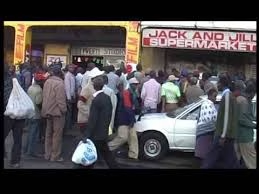
During the late 1990s and early 2000s:
- Nairobi’s middle class was expanding.
- Urban retail culture was growing.
- Supermarkets were becoming social spaces.
Jack and Jill benefited from this shift. It was strategically located and heavily patronized.
However, behind the scenes, the retail industry was becoming more competitive.
What Went Wrong?
Like many Kenyan supermarket chains that collapsed, Jack and Jill’s fall did not happen overnight. It was gradual.
Several factors contributed:
1. Intense Competition
As Kenya’s retail market expanded, larger and more aggressive players entered the scene. Chains like Nakumatt began expanding rapidly, opening branches across major towns.
Later, international brands like Carrefour (which entered Kenya years after Jack and Jill’s decline) would change the retail game completely with modern systems and global backing.
Smaller chains struggled to keep up.
2. Financial Strain
Retail is a cash-flow-heavy business. Supermarkets operate on thin margins. If stock turnover slows or debts accumulate, the pressure builds quickly.
While detailed public financial records are limited, reports and business circles indicated that Jack and Jill faced financial difficulties, including supplier payment challenges.
Once suppliers lose confidence, shelves start thinning. Customers notice. Sales drop. The cycle becomes hard to reverse.
3. Management and Structural Challenges
Many early Kenyan retail chains were family-run businesses. As operations grew more complex, professional management structures became essential.
Chains that failed to adapt to modern corporate systems, inventory management technologies, and expansion strategies often struggled to survive in a rapidly evolving market.
The Closure
Eventually, Jack and Jill shut down its operations. For many Nairobi residents, it was shocking but not entirely surprising. The shelves had become inconsistent. Competition had intensified. The brand had lost its earlier spark.
Its prime CBD location did not stay empty for long. New businesses took over, reflecting the constant change in Kenya’s retail landscape.
Jack and Jill quietly faded into history.
A Pattern in Kenya’s Retail Industry
Jack and Jill’s story mirrors that of several Kenyan supermarket chains.
- Uchumi went into administration.
- Nakumatt collapsed dramatically.
- Tuskys also faced closure.
The Kenyan retail industry has experienced repeated cycles of growth and collapse.
Why?
Because rapid expansion without sustainable financial control often leads to crisis. Supermarkets borrow heavily to expand. When cash flow tightens, debts overwhelm operations.
Jack and Jill may not have collapsed as dramatically as Nakumatt, but it became one of the early lessons in retail vulnerability.
Where Is the Owner Now?
Businessman Atul Shah has maintained a relatively low public profile regarding Jack and Jill after its closure. Unlike some retail collapses that involved public court battles and high-profile investigations, Jack and Jill’s decline was quieter.
This silence has left many Kenyans curious about what exactly transpired behind closed doors.
Lessons from Jack and Jill’s Collapse
The fall of Jack and Jill offers important lessons for Kenyan entrepreneurs:
1. Growth Must Be Sustainable
Expanding too fast without strong financial backing can destabilize a business.
2. Cash Flow Is King
In retail, supplier relationships depend on consistent payments.
3. Competition Evolves Quickly
Businesses must adapt to modern systems, technology, and consumer expectations.
4. Brand Loyalty Is Not Permanent
Customers shift quickly when shelves are empty or prices rise.
Why Kenyans Still Remember Jack and Jill
Despite its disappearance, Jack and Jill remains nostalgic for many Nairobi families.
It represents:
- Childhood shopping trips
- Affordable festive seasons
- Simpler retail times
- Early modern supermarket culture
It was part of Kenya’s retail evolution.
Today, walking through modern malls with international chains, it is easy to forget that brands like Jack and Jill paved the way.
Final Thoughts
Jack and Jill was owned by Atul Shah, a Kenyan businessman who built one of Nairobi’s most memorable supermarket brands. However, due to competitive pressure, financial challenges, and structural shifts in Kenya’s retail market, the chain eventually closed its doors.
Its story reflects the volatile nature of Kenya’s supermarket industry.
Retail success can feel permanent. But in reality, it requires constant reinvention, financial discipline, and adaptability.
Jack and Jill may be gone, but it remains a powerful reminder that even the biggest brands can fade if they fail to evolve.
More Stories: https://www.whispers.co.ke/
Follow us: https://www.facebook.com/WhispersNewsNow
