

Introduction
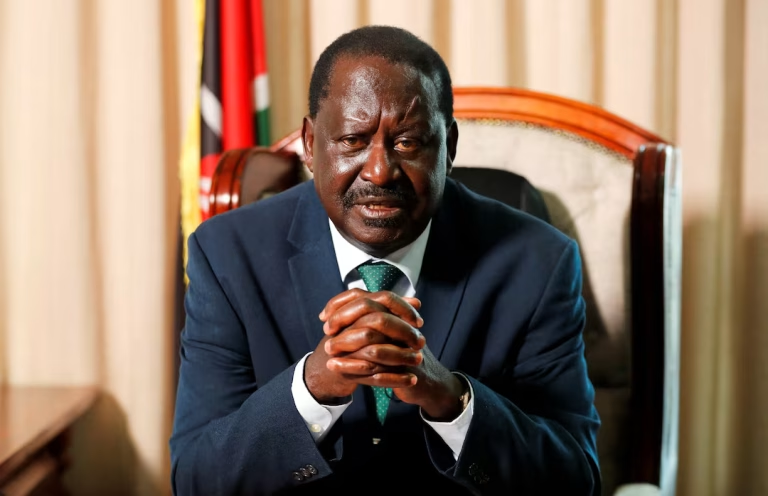
Few names in African politics command as much respect, admiration, and debate as Raila Amolo Odinga. Known to his supporters as Baba, Raila Odinga’s life story is one of courage, resilience, and unbroken pursuit of justice for the Kenyan people. The Raila Odinga biography is not merely the story of a politician; it is the chronicle of a man who helped shape Kenya’s democratic landscape across four decades of struggle.
Early Life and Education
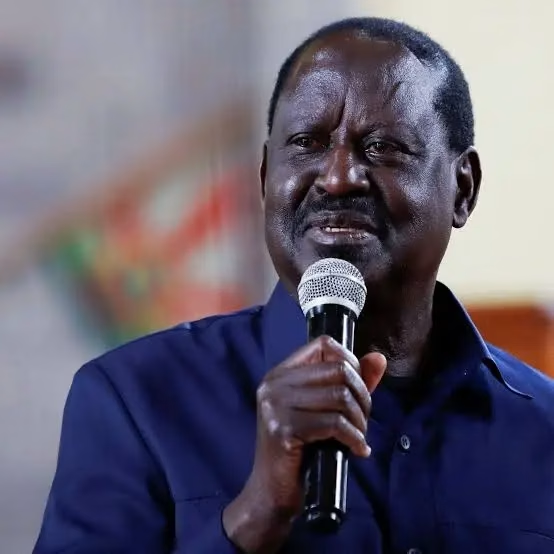
Raila Amolo Odinga was born on January 7, 1945, in Maseno, Kisumu County, to Jaramogi Oginga Odinga and Mary Juma Odinga. His father, Jaramogi, was Kenya’s first Vice President and a key ally of Jomo Kenyatta during the independence struggle.
Growing up in the politically charged environment of post-colonial Kenya, young Raila learned early the value of justice, resistance, and public service.
He attended Maranda High School before moving to East Germany on a scholarship in the 1960s, where he studied Mechanical Engineering at the Technical University of Magdeburg. He later returned to Kenya in 1970 with a degree and a passion for nation-building.
Early Career and Detention
Upon his return, Raila worked as a lecturer at the University of Nairobi and later at the Kenya Bureau of Standards. However, it wasn’t long before he was drawn into the growing movement against one-party rule under President Daniel arap Moi.
In 1982, following the failed coup attempt against Moi’s regime, Raila was arrested and detained without trial for six years. He would face detention several times—spending a total of close to a decade behind bars—for his role in pushing for political pluralism and human rights.
These years of imprisonment shaped his political philosophy and earned him both local and international recognition as a symbol of resistance against dictatorship.
The Return to Multi-Party Politics
When Kenya transitioned to a multi-party system in the early 1990s, Raila emerged as a key figure in the opposition. He joined the Forum for the Restoration of Democracy (FORD), a coalition founded by his father, before eventually forming FORD-Kenya.
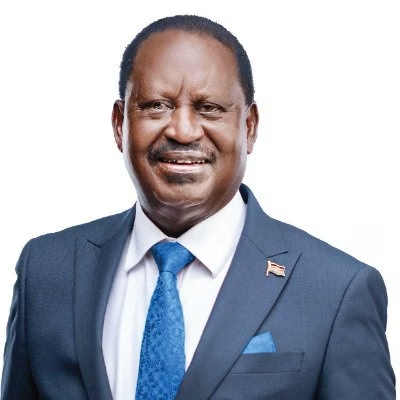
After Jaramogi’s death in 1994, Raila struggled for control of the party, later leaving to join the National Development Party (NDP), through which he built a formidable political base.
His charisma and populist approach earned him massive grassroots support, especially in the Nyanza region and urban centres across the country.
Alliance with Moi and Birth of ODM
In a surprising political twist, Raila’s NDP merged with KANU in 2001, briefly aligning him with President Moi. However, after Moi endorsed Uhuru Kenyatta as his preferred successor in 2002, Raila led a mass exodus from KANU and joined forces with Mwai Kibaki, Kalonzo Musyoka, Charity Ngilu, and others under the National Rainbow Coalition (NARC).
Their unity brought an end to KANU’s 40-year rule as Kibaki won the 2002 election. Raila’s rallying cry—“Kibaki Tosha!”—became one of the most iconic phrases in Kenyan political history.
However, tensions later grew within NARC, leading Raila and his allies to form the Orange Democratic Movement (ODM) ahead of the 2005 constitutional referendum. ODM became one of the most powerful opposition parties Kenya has ever known.
The 2007 Election and Post-Election Violence
The 2007 general election remains one of the darkest chapters in Kenya’s political history. Raila, running under the ODM ticket, faced off against incumbent President Mwai Kibaki.
When the Electoral Commission of Kenya declared Kibaki the winner amid widespread allegations of vote rigging, Kenya erupted into chaos. The post-election violence claimed over 1,100 lives and displaced hundreds of thousands.
Raila’s unwavering call for peace led to a power-sharing agreement brokered by Kofi Annan, in which he became Kenya’s second Prime Minister in 2008, serving until 2013.
Raila as Prime Minister (2008–2013)
As Prime Minister, Raila spearheaded key reforms, including efforts to modernize infrastructure, promote national unity, and implement the new 2010 Constitution.
His administration also introduced the Vision 2030 framework—Kenya’s long-term development blueprint—focused on transforming the nation into a middle-income economy.
Despite political rivalries, Raila earned global respect for his statesmanship, visionary leadership, and commitment to constitutional governance.
Subsequent Elections: 2013, 2017, and 2022
Raila Odinga contested the presidency several times—2013, 2017, and 2022—each time under different coalitions (CORD, NASA, and Azimio la Umoja).
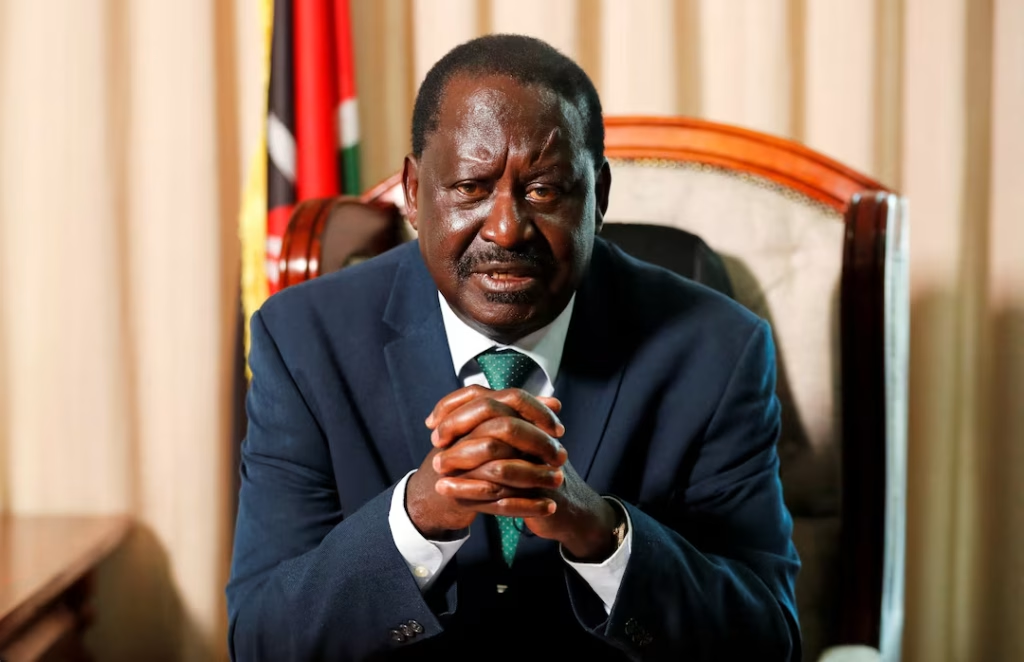
In 2017, his legal challenge of the presidential results led to a historic Supreme Court ruling that nullified the election—the first such ruling in Africa. Though he boycotted the rerun, the event solidified his legacy as a champion of electoral justice.
In 2018, he shocked the nation with the now-famous “Handshake” with President Uhuru Kenyatta, a political truce that calmed tensions and ushered in the Building Bridges Initiative (BBI), aimed at uniting Kenyans and reforming governance structures.
Legacy and Influence
Raila Odinga’s influence transcends politics. He has become a symbol of resilience, reform, and hope for millions of Kenyans.
Whether viewed as a revolutionary or a controversial figure, his contribution to Kenya’s democratic journey is undeniable. His followers call him “the people’s president”—a title that captures the depth of his connection to ordinary Kenyans.
Raila also mentored a generation of leaders, inspiring movements for youth inclusion, devolution, and electoral fairness. His impact extends across Africa, where he served as African Union High Representative for Infrastructure Development, advocating for continental integration.
Personal Life
Raila Odinga was married to Ida Betty Odinga, a former teacher and education advocate. The couple had four children: Fidel (late), Rosemary, Raila Jr., and Winnie.
Despite his political commitments, Raila was known for his love of football, reggae music, and family life. His humility and charisma made him one of the most approachable national leaders in Kenya’s history.
Death and Tributes (2025)
On October 15, 2025, Raila Odinga passed away at the age of 80 while receiving treatment in India. His death sent shockwaves across Kenya and Africa.
Leaders from across the globe paid tribute, describing him as “a freedom fighter who never gave up on democracy.” Streets in Nairobi, Kisumu, and Mombasa were filled with emotional mourners singing liberation songs that defined his political journey.
The ODM party, his lifelong political home, declared seven days of mourning, calling him “the eternal flame of Kenya’s democracy.” https://nation.africa/kenya/news/politics/live-blog-raila-odinga-kenyan-political-titan-dies–5230730
Conclusion
Raila Odinga’s life remains a lesson in endurance, conviction, and love for one’s country. The Raila Odinga biography will forever stand as the story of a man who endured imprisonment, political betrayal, and countless defeats—but never surrendered his dream for a better Kenya.
In the hearts of millions, Baba lives on as a symbol of hope, courage, and freedom. Read more stories https://www.whispers.co.ke/
