


The Odinga family has made a public appeal for financial contributions toward the funeral expenses of the late Beryl Achieng Odinga, a gesture that has caught national attention and stirred widespread debate. The appeal, led by Ruth Odinga, invited friends, relatives, and Kenyans of goodwill to support the family as they prepare to lay Beryl to rest at the historic Kang’o Ka Jaramogi grounds in Bondo, Siaya County.
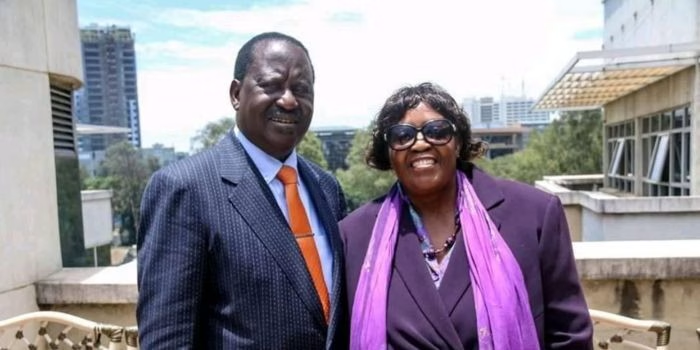
A memorial mass and a small fundraising gathering were held in Nairobi as part of the funeral preparations. The family described the events as moments of prayer, reflection, and unity—an opportunity for those who knew Beryl to honour her legacy and offer support.
But beyond the mourning and the logistics, it is the public nature of the financial appeal that has left many Kenyans surprised.
Why the Appeal Shocked Many Kenyans
For decades, the Odinga family name has been synonymous with influence, political prominence, and national stature. They are one of Kenya’s most recognisable political dynasties, having shaped national discourse for generations.
Seeing such a family turn to the public for financial help raised several questions:
- Many assumed that the Odinga family, given its long-standing status, would have the resources to manage funeral expenses privately.
- The request came shortly after the family’s immense emotional toll from the deaths of both Raila Odinga and Beryl Achieng within months—something that has kept them in the public eye and intensified public scrutiny.
- It challenged widespread assumptions about the financial security of political families, revealing a more human, vulnerable side that the public rarely sees.
For some Kenyans, the appeal was a refreshing sign of humility. For others, it was puzzling—perhaps even symbolic of broader shifts in political influence.
Does the Appeal Signal a Loss of Power?
The meaning behind the Odinga family’s request can be interpreted in several ways, each reflecting different facets of Kenya’s political culture.
A Show of Humility
The family may simply be embracing communal values that are deeply rooted in Kenyan society. Funerals—especially for prominent figures—are costly and logistically demanding. Turning to the public may have been a practical choice and a reflection of the family’s willingness to remain open and connected to ordinary Kenyans.
A Practical Decision
Medical bills, memorial events, transportation, and burial arrangements add up quickly. Even influential families face unexpected financial pressure during prolonged tragedies. The appeal might be a realistic step rather than a symbolic one.
A Possible Shift in Public Perception
However, the public call for donations inevitably affects perception. Political dynasties often rely on an aura of stability, strength, and self-reliance. Opening a funeral fund could give some an impression—fair or not—of diminished financial or political power.
In Kenya, where optics matter almost as much as politics itself, such gestures can lead to speculation. But it could also reinforce the Odingas’ connection with ordinary citizens, showing that even the most prominent families experience hardship.
What This Means for Kenya
The Odinga family’s appeal has opened a broader conversation about the realities behind public life:
- Even prominent families are not immune to financial and emotional strain.
- Public expectations of political families may need reassessment—wealth is not guaranteed simply because of prominence.
- Community support remains central to Kenyan culture, regardless of class, status, or lineage.
For the Odingas, the response they receive may become a measure of how Kenyans continue to relate to the family at a time of transition and grief. For Kenya as a whole, the moment serves as a reminder that humanity transcends status—and that vulnerability can sometimes build stronger bonds than power.
Conclusion
The Odinga family’s public request for financial assistance to bury Beryl Achieng is more than a simple fundraiser. It is a moment that sparks reflection on power, humility, legacy, and community. Whether the gesture signals a loss of political influence or simply a rare moment of openness depends on one’s perspective.
But one thing is undeniable: grief has a way of uniting people, and in this moment, the Odinga family stands not as a political powerhouse, but as a Kenyan family seeking support during a difficult time.
Follow us on X: https://x.com/Whispersnewsnow
