


Introduction
The Social Health Authority (SHA) was introduced in late 2024 to replace the troubled NHIF. It was branded as the dawn of a new era where Kenyans could finally access affordable and reliable healthcare. Barely a year later, that dream has collapsed into a nightmare.

Instead of fixing the loopholes that drained NHIF, SHA is now at the center of a multi-billion shilling scandal involving ghost facilities, unpaid hospital claims, and a procurement deal so inflated it left the country in shock.
A New Authority with Old Problems
When SHA was unveiled under the Social Health Insurance Act of 2023, its promise was bold:
- End years of corruption.
- Digitize medical claims to cut fraud.
- Guarantee every Kenyan healthcare without financial struggle.
But in less than 12 months, it was already walking in the footsteps of NHIF—only this time, the figures involved were far larger.
The Sh104 Billion Procurement Storm
In March 2025, the Auditor General revealed that SHA’s digital system cost taxpayers a staggering Sh104 billion. What angered Kenyans most was not just the price tag, but how the contract was awarded.

- No open tender.
- Money routed through secret escrow accounts.
- Strange deductions (2.5% and 5%) that no one could fully explain.
For many, this confirmed their worst fears—that SHA was never designed to serve citizens, but to feed a hungry network of contractors and insiders.
Ghost Facilities and Fake Patients
As Kenyans digested the procurement scandal, another shocking revelation emerged.

Investigations showed that SHA had been paying out millions to non-existent or fraudulent health facilities:
- A closed maternity hospital received Sh5 million.
- A non-existent clinic in Homa Bay pocketed Sh2.8 million.
- A “nursing home” registered just a day before payout got Sh3.8 million, despite not having a physical location.
Meanwhile, real hospitals treating genuine patients were left with billions in unpaid claims, forcing many to stop accepting SHA cards.
The Human Cost: Patients Locked Out
By August 2025, unpaid claims had ballooned to over Sh75 billion, leaving hospitals in financial crisis. Patients who had faithfully contributed to the new fund were shocked to find that:
- Many hospitals refused to admit SHA patients.
- Families were forced to pay cash, often borrowing money to cover bills.
- SHA scrapped monthly premiums, demanding full annual payments upfront—a move that locked out many low-income Kenyans.
Instead of protecting families from poverty caused by illness, SHA was pushing them deeper into it.
Outrage Across the Country
The scandal triggered a wave of anger both online and offline. Kenyans flooded social media with hashtags like #SHAScandal and #HealthCareTheft, sharing stories of loved ones stranded in hospitals.
See morehttps://www.youtube.com/watch?v=4AkKX_TZaxo
One frustrated patient summed it up bluntly:
“SHA is not working. We are tired of being lied to.”
The anger escalated further when SHA quietly pulled down its online list of hospital payments, a move many saw as an attempt to cover its tracks instead of coming clean.
Civil society groups called the scandal a national crisis, warning that the collapse of trust in SHA could kill Kenya’s dream of universal healthcare.
Video Reactions: The Scandal in Motion
Pressure on Leaders
The heat has now shifted to the leadership of SHA and the Ministry of Health.

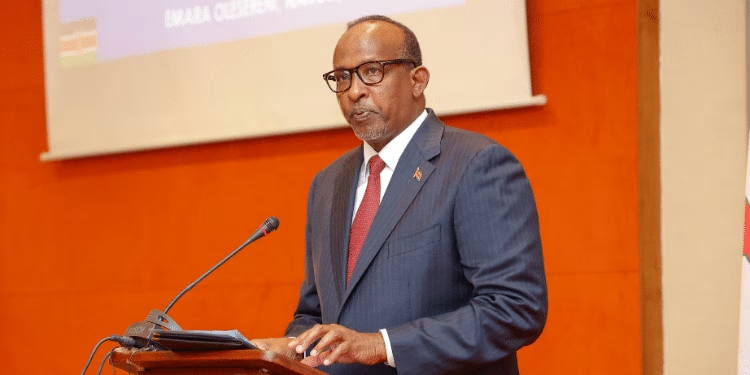
- Opposition politicians have demanded the resignation of Health CS Aden Duale and SHA CEO Mercy Mwangangi, accusing them of presiding over fraud.
- Activists are pushing for a Commission of Inquiry to expose everyone who benefitted from the scheme.
- The government, however, insists SHA is still the answer, with CS Duale claiming it is the first system in decades that can detect fraud in real time.
For many Kenyans, those words feel like too little, too late.
What Kenya Must Do Next
The SHA scandal has proven that simply renaming an institution doesn’t solve deep-rooted corruption. For Kenya to move forward, three urgent steps are needed:
- Accountability – Those who benefitted from fraudulent contracts and ghost payments must face justice.
- Transparency – Payment records and audits must be made public to restore trust.
- Accessibility – Premiums must be structured so that even low-income families can afford coverage.
Without these reforms, SHA risks collapsing entirely, leaving millions without a safety net.
Conclusion
The SHA was supposed to bring relief to Kenyan families who had long suffered under NHIF. Instead, it has become a symbol of betrayal, draining billions and leaving patients stranded.
Kenyans are angry—and rightfully so. Whether the government listens and acts will determine if SHA survives, or if it joins the long list of failed promises.
The big question now is: will justice be done, or will history repeat itself? Read more stories https://www.whispers.co.ke/
