

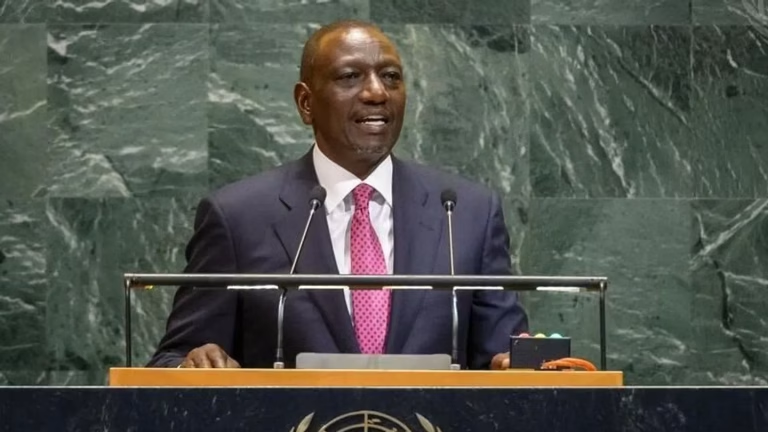
When Kenya’s President William Ruto speaks on global platforms, he often carries with him the weight of Africa’s voice — a voice that has been ignored, marginalized, and, at times, silenced in international decision-making. One institution that has particularly drawn his sharp criticism is the United Nations Security Council (UNSC).
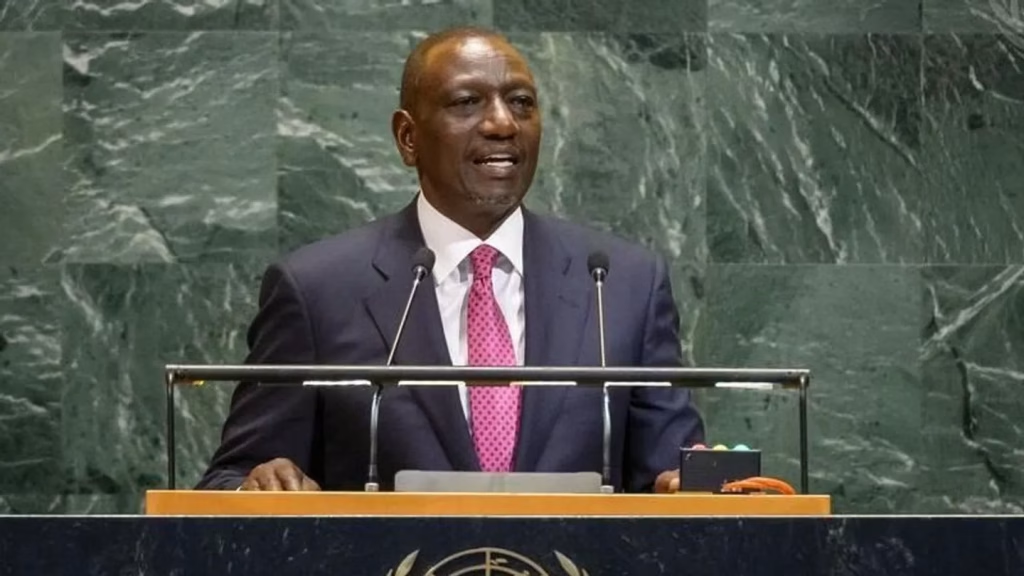
To many, the UNSC is supposed to be the highest seat of global authority on matters of peace and security. But to President Ruto and many African leaders, the Council has become a body struggling with legitimacy. Its credibility is being eroded by outdated structures, selective justice, and double standards that expose the cracks in the very institution meant to guarantee global stability.
So why exactly is President Ruto worried about the credibility of the Security Council?
1. Decisions About Africa Without Africa
It is an uncomfortable truth: over 70 percent of the Security Council’s agenda involves Africa. From Somalia’s instability, Sudan’s war, and the Democratic Republic of Congo’s endless cycles of violence, to the Sahel’s insurgencies, Africa dominates the UNSC’s schedule.
Yet Africa itself has no permanent seat on the Council. The continent only rotates two or three non-permanent seats, meaning its role is largely consultative rather than decisive. Permanent members — the United States, the United Kingdom, France, Russia, and China — enjoy veto powers that can override any proposal, regardless of Africa’s wishes.
For Ruto, this imbalance highlights a global order that is neither democratic nor representative. How can the continent most affected by the Council’s decisions lack a permanent voice at the table?
Kenya has felt this directly. During its two-year stint on the UNSC (2021–2022), under President Uhuru Kenyatta and later Ruto, Kenya often found itself pushing against powerful interests when advocating for African-led solutions. Despite being on the table, Kenya still lacked the influence of permanent members, underscoring Africa’s structural disadvantage.
2. Double Standards in Responding to Crises
Ruto has also raised eyebrows at how the Council selectively responds to crises around the world.
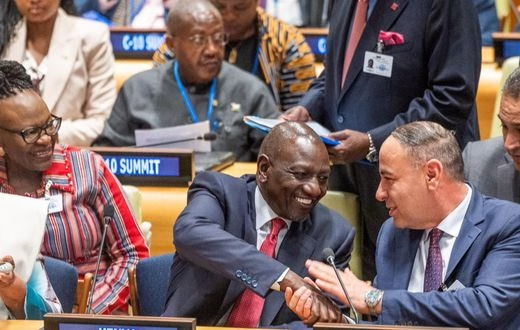
Take the war in Ukraine, for example. The UNSC convened emergency meetings, passed swift resolutions, and rallied resources to address the crisis. In contrast, when Sudan descended into civil war in 2023, the response was painfully slow. Eastern Congo’s humanitarian tragedy has dragged on for decades with limited urgency. Somalia’s instability continues to be managed, not solved.
For Kenyans, this imbalance is easy to see. Kenya has long hosted thousands of Somali refugees fleeing Al-Shabaab terror and state collapse, yet international action has remained sluggish. In contrast, the Ukraine conflict drew billions of dollars in aid within months.
This unequal treatment sends a disturbing message: some lives matter more than others. Ruto insists that until the Council treats African crises with the same urgency as European or Middle Eastern ones, its credibility will remain in doubt.
3. The Problem of the Veto
Perhaps the most glaring flaw in the UNSC’s structure is the veto power. The five permanent members (the P5) — US, UK, France, Russia, and China — each hold the ability to block any resolution, regardless of how many countries support it.
This means that the Council often becomes a hostage of geopolitics rather than a vehicle for peace. For example:
- Russia repeatedly vetoes resolutions critical of its actions in Ukraine.
- The US has vetoed numerous resolutions concerning Israel and Palestine.
- China and Russia block actions that might weaken their allies in Africa and Asia.
This paralyzing system ensures that global justice is sacrificed at the altar of national interests.
For Kenya, this has played out in the Somalia maritime dispute case. Although the matter was settled by the International Court of Justice, there were concerns about how global politics could override legal rulings if the UNSC had been directly involved. Ruto views this as a reminder that without reform, African justice will always be vulnerable to the politics of the powerful.
4. Peacekeeping Without Peace
Another issue eroding the Council’s credibility is its reliance on long-term peacekeeping missions in Africa that rarely deliver lasting solutions.
- The UN mission in the Democratic Republic of Congo (MONUSCO) has been on the ground for over two decades with limited success.
- In Somalia, the African Union Mission (AMISOM), later rebranded as ATMIS, has fought militants for years, yet Al-Shabaab remains resilient.
For Kenyans, this is not a distant issue. Kenyan troops under AMISOM have been in Somalia since 2011, carrying the burden of regional security. Yet, despite sacrifices of Kenyan soldiers and resources, the UNSC-backed mission has often felt like a treadmill — endless deployments without a clear exit strategy.
Families in Kenya continue to lose loved ones in attacks like El Adde and Kulbiyow, where scores of Kenyan soldiers were killed. For Ruto, this highlights the UNSC’s failure to provide comprehensive solutions beyond military interventions.
5. Geopolitics Over Justice
The Security Council is supposed to serve global peace. Instead, it is often used as a battleground for great power competition.
In Africa, this has meant that conflicts are not addressed on the basis of humanitarian need but rather on how they serve the interests of powerful nations. Whether it is about access to resources like oil, cobalt, or rare earths, or about securing military bases and strategic alliances, global powers have been accused of using the Council to manipulate African crises for their benefit.
Kenya has seen this first-hand. In the Horn of Africa, superpower competition has fueled instability, with countries being courted by both the West and China. Ruto’s government, aware of this, has repeatedly warned that unless the UNSC reforms, it will continue being seen as a pawn of big powers rather than a platform for impartial justice.
6. The Risk of Irrelevance
Perhaps the biggest reason for Ruto’s concern is the risk that the UN Security Council becomes irrelevant in the emerging world order.
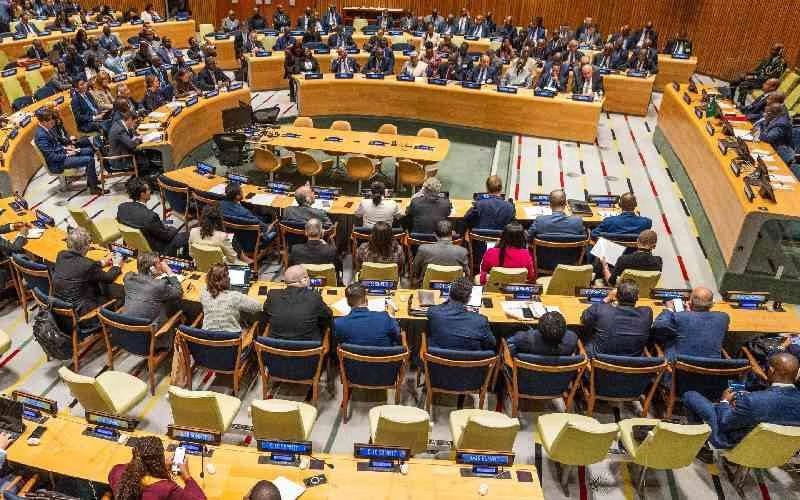
The global system is no longer unipolar. Regional blocs such as the African Union, ECOWAS, BRICS, and the East African Community are increasingly stepping in to handle conflicts. When the UNSC drags its feet, these organizations often fill the vacuum.
For example:
- ECOWAS has taken decisive action during coups in Mali and Niger.
- The AU has led mediation in Ethiopia’s Tigray conflict.
- Kenya itself mediated the peace process in South Sudan, showing how African countries can take the lead.
Ruto argues that if the UNSC fails to reform, countries and regions will bypass it altogether, leaving it as a relic of history rather than a living institution.
7. Kenya’s Diplomatic Position
Kenya has not been silent on these issues. During its tenure on the Security Council (2021–2022), Kenya consistently called for multilateralism that respects fairness and inclusivity. Under Ambassador Martin Kimani, Kenya made headlines by boldly condemning Russia’s invasion of Ukraine while linking it to Africa’s own colonial history of forced borders.
This was a clear example of Kenya using its seat to speak not just for itself but for the continent. Ruto has extended this push, positioning Kenya as a voice for Africa and the Global South. His frequent calls for UN reform are not just about Africa’s pride but also about protecting the credibility of multilateral institutions.
Conclusion: A Council at a Crossroads
President William Ruto’s worries about the UN Security Council’s credibility are not misplaced. The Council faces a legitimacy crisis born of outdated structures, unequal treatment, veto paralysis, and geopolitical manipulation. Watch more https://www.youtube.com/watch?v=51Fu1GZC0UA
For Africa, which bears the brunt of the Council’s decisions without permanent representation, this crisis is even more urgent. Ruto’s warning is clear: if the Council does not reform, it risks becoming irrelevant in a world that is increasingly multipolar and impatient with selective justice.
The UNSC was designed in 1945, in the shadow of a world war. But the world of 2025 is radically different. If it cannot evolve to represent today’s realities, then leaders like Ruto — and the billions they represent — may begin to look elsewhere for solutions. And when that happens, the Council’s credibility may not just be in question; it may be permanently lost.
Read other stories https://www.whispers.co.ke/815/celebrities/2025/jaymoh-decin-why-you-know-so-little-about-him-who-is-he/
