

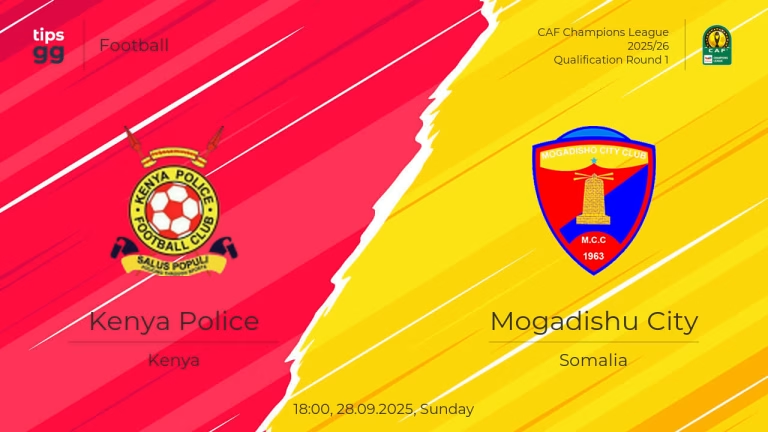
When Mogadishu City Club supporters were caught on camera desecrating the Kenyan flag during a CAF Champions League clash, outrage swept across the country. The Interior Ministry declared that apologies alone would not be enough, and investigations into individual fans are already underway. But as Kenya doubles down on enforcing respect for its symbols, one question remains worth asking: what about the fans’ perspective? And how does Kenya’s approach compare globally?

Fans and the “Heat of the Moment” Defense
For many football supporters, passion often runs ahead of reason. In the heat of competition, flags, banners, and even anthems sometimes become tools of provocation. From a fans’ perspective, disrespecting a rival’s flag may not have been a calculated political insult but rather an act of hooliganism—immature, offensive, but rooted in rivalry rather than geopolitics.
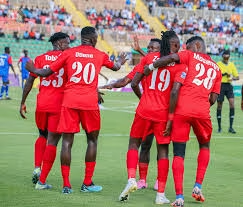
Supporters could argue:
- It wasn’t about Kenya, it was about Kenya Police FC. In their minds, attacking the symbol was a way of mocking the team, not the entire nation.
- No intent to insult sovereignty. They may claim ignorance of how deeply Kenyans revere their flag under national law.
- Spontaneous behavior. In the charged atmosphere of a stadium, individual actions spread quickly in a mob-like fashion, with fans feeding off each other’s energy.
Of course, from Kenya’s standpoint, these arguments carry little weight—intent does not erase impact. Still, understanding the mindset helps explain why fans might feel the Interior Ministry’s hard stance is excessive.
Global Comparisons: How Other Nations Respond
Kenya is not alone in treating the flag as sacred. Around the world, countries have faced similar cases, often with equally emotional responses.
- United States:
- The U.S. Supreme Court ruled in 1989 (Texas v. Johnson) that burning the American flag is protected free speech.
- Yet public outrage is often fierce, and in practice, those who desecrate the U.S. flag face heavy social backlash even if not criminal punishment.
- India:
- The flag is legally protected under the Prevention of Insults to National Honour Act. Desecration—including stepping on or burning—is punishable by imprisonment up to three years.
- Indian courts have upheld strict enforcement, especially in sports or protests.
- Turkey:
- Disrespecting the national flag is a criminal offense carrying prison sentences. Even foreign nationals have been prosecuted, signaling zero tolerance.
- United Kingdom:
- No law prohibits flag desecration, but hooligans who damage flags in public are often charged under public order or criminal damage laws.
- South Africa:
- The flag is highly symbolic of post-apartheid identity. Desecration sparks strong social outrage, and offenders may face hate-speech or incitement charges.
By these comparisons, Kenya’s stance aligns more closely with countries like India or Turkey, which treat the flag as a protected national symbol, rather than the U.S. or U.K., where free speech offers a wider shield.
Balancing Justice and Diplomacy
Kenya’s decision to pursue legal action against individual MCC supporters raises a broader question: how far should justice go when foreign nationals are involved?
- Strict enforcement reinforces Kenya’s sovereignty and sends a deterrent message.
- Diplomatic sensitivity reminds authorities that Somalia and Kenya share complex political and cultural ties, and mishandling the matter could inflame tensions.
Some Kenyans argue that deportation and bans from future matches may be a more practical penalty than lengthy prosecutions. Others insist that only a public trial can demonstrate the seriousness of the crime. Watch more here https://www.youtube.com/watch?v=8BH8TY27L6Y
Closing Thoughts
From the fans’ perspective, what happened might have been a reckless act of hooliganism rather than a deliberate political insult. But from Kenya’s perspective, no amount of “heat of the moment” passion can excuse trampling on the national flag.
This clash of perspectives is not unique to Kenya—it echoes global debates about the meaning of national symbols, free expression, and respect. At the end of the day, the incident forces us to ask: in a world where sports passion often spills into disrespect, how do nations balance forgiveness, accountability, and the sacredness of identity? Read more on the issue https://www.whispers.co.ke/831/sports/2025/why-kipchumba-morkomen-and-his-team-think-that-mogadishu-city-club-apology-is-not-enough/
